
Why La Casa Azul Is Worth the Visit
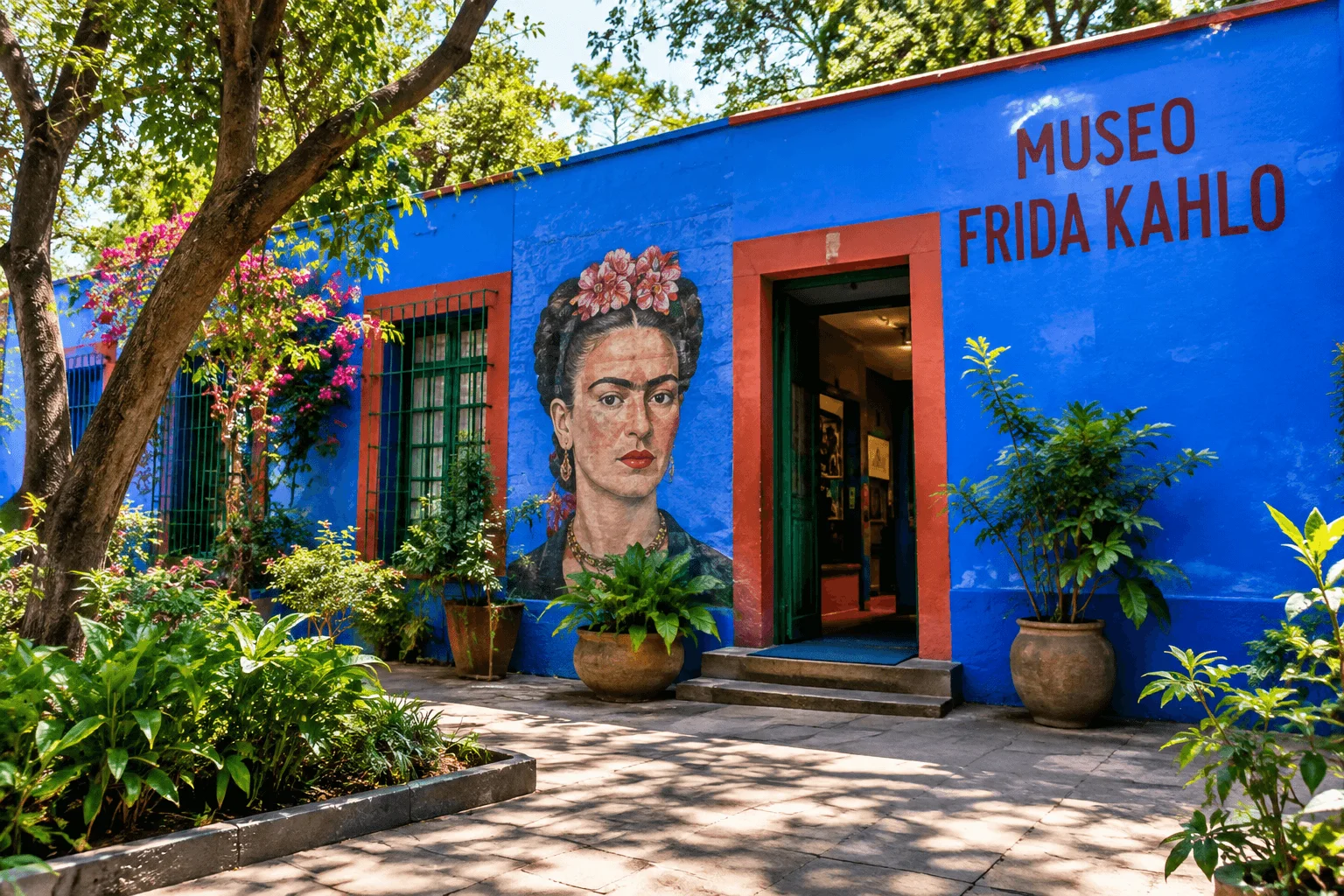
A visit to the Frida Kahlo Museum in Mexico City feels different from walking through a regular museum. Casa Azul, also called La Casa Azul or The Blue House, stands out with its bright medium blue and maroon walls. This vibrant space sits in the heart of Coyoacán and gives you an intimate glimpse into Frida Kahlo’s life, work, and history.
Frida, the iconic painter, was born, lived, and died in this house. She spent most of her life here and created much of her work in this home. After her death, the house was donated to the people of Mexico. It became a cultural icon and a mecca for lovers and every art lover interested in her story. From my experience exploring cultural sites, this kind of setting makes the visit feel personal rather than simply educational.
The story becomes even more meaningful when you learn what shaped her career. Frida Kahlo, 1907–1954, became the most famous female Latin American artist in history, a politically active feminist, and a cultural icon.
As a child, she faced health issues, including polio. At age 18, she survived a bus accident that caused physical hardship and required multiple surgeries throughout her lifetime.
She married Diego Rivera twice, and her career was once overshadowed by the artist who was often known as the guy who was married to Frida Kahlo. Today, that view has largely reversed.
If you are visiting Mexico’s capital for the first time, this trip to the Frida Kahlo Museum Mexico City belongs at the top of your list. The recognizable blue home is a worthwhile gem, a must see place for anyone who wants an unforgettable cultural experience and a closer look at the woman behind the art.
Quick Answer
La Casa Azul, the Frida Kahlo Museum in Mexico City, is worth visiting because it offers an intimate look into Frida Kahlo’s life, art, and personal struggles.
Inside the famous Blue House, you can see her paintings, dresses, jewelry, photographs, journals, furniture, corsets, wheelchair, and other personal belongings. Highlights include her final painting, Viva la Vida, Watermelons, her artist’s studio, famous bed, and the colorful courtyard with its Aztec pyramid, gardens, ponds, and sculptures.
Visitors can also explore the streets of Coyoacán and take part in a self-portrait painting activity. Overall, Casa Azul connects Frida’s artwork with the home and experiences that shaped her life.
Frida’s Dresses and Jewelry
At La Casa Azul, some rooms have been transformed into a museum and gift shop. Another section of the house across the courtyard displays Frida’s personal adornments.
You can see her famous clothing, accessories, knick-knacks, books, and memorabilia in a museum setting. The displays also include dolls that Frida made in her own likeness.
Among the clothing and jewelry, a white earring shaped like a hand stands out. Pablo Picasso gifted it to her, and she wore it in the self-portrait dedicated to Dr. Eloesser in 1940.
The collection also shows her wheelchair, corsets, crutches, and other devices that helped her walk and supported her spine issues. Her shoes come in two different sizes. One shoe always has a lift to accommodate her shorter leg.
Seeing these objects together makes her daily life feel much more tangible.
Her Dressing Table
Frida’s cremains rest in a toady urn on her dressing table, which now serves as something of a shrine. The Frida Kahlo House display preserves this deeply personal area inside the Frida Kahlo Museum in Mexico City.
A photographer focused on the display and was surprised to see himself appear in the photograph. The scene gives visitors another personal connection to Frida beyond her paintings. It shows how her belongings, furniture, and final resting place remain part of the house’s story.
Personal Artifacts
Frida’s personal artifacts reveal the depth of her personal story, especially her Tehuana dresses and orthopedic corsets.
These items connect her clothing and appearance with the physical challenges she experienced throughout her life. Her dresses, corsets, jewelry, and other belongings help visitors understand that her personal style was closely connected to her identity and experience
Paintings
Frida’s last painting, Viva la Vida, Watermelons, remains inside the home, with its title roughly translated as Long live life.
The Frida Kahlo House holds a relatively small collection of her paintings. Other works appear in museums and museum collections around the world, including New York, San Francisco, Washington DC, Los Angeles, and Paris.
The select works at the Frida Kahlo Museum in Mexico City are inspiring and offer visitors a closer look at her artistic vision.
One notable painting, Frida and the Cesarean, dates to 1932 and reflects a deeply personal experience from Kahlo’s life. She became pregnant while she and Diego Rivera were in Detroit in 1932.
She chose an induced abortion, but it failed. Doctors told her she could carry the baby to term and deliver by Cesarean section. Instead, she experienced a difficult miscarriage.
In Frida and the Cesarean, Kahlo presents the fetus in several simultaneous forms. It appears inside her belly, being removed by doctors in the upper left, and as a newborn beside her in the bed.
Diego Rivera also appears in the scene, along with flasks containing the solutions used during the failed abortion. Kahlo captures her vulnerability while exploring both real and imagined outcomes.
This powerful work demonstrates how she transformed personal pain and difficult experiences into visual art. It also makes the painting an important part of understanding her work and the emotional depth behind her paintings.
Her Worktable
Frida Kahlo’s worktable at the Frida Kahlo Museum in Mexico City, Mexico offers a small but interesting look at her workspace.
The table appears to sit beside stained-glass windows. However, the effect comes from clear glass panes arranged in different widths.
The colors outside in the courtyard create the illusion of stained glass. This gives the area a distinctive appearance and shows how the surrounding space influenced the atmosphere of her home.
Paint Your Own Self-Portrait!
After exploring the Frida Kahlo Museum in Mexico City, visitors can end their experience by connecting with their own inner Frida Kahlo and creating a self-portrait in the courtyard.
The activity invites budding artists to paint their own artwork, with supplies provided. From my perspective, this hands-on activity adds a creative touch to the visit and lets you experience the artistic spirit of Frida Kahlo in a simple, personal way.
Photographs
The Frida Kahlo Museum in Mexico City holds a huge collection of photographs that documents her entire life.
The images show Frida as a girl, woman, patient, painter, activist, and Diego Rivera’s partner. They give visitors a broader view of the person behind the famous artist.
One memorable photograph captures Frida Kahlo and Diego Rivera on their wedding day, August 21, 1929. The scene looks strikingly similar to Kahlo’s painting of herself and Diego that hangs at the San Francisco Museum of Modern Art.
As you explore Casa Azul, you can also see her original art, personal belongings, photographs, and iconic dresses.
More than a simple museum, Casa Azul immerses you in the world of Frida and Diego Rivera. It also reflects their creative energy, political beliefs, and love for Mexican culture.
A Glimpse Into Frida’s Private Pain
When you’re touring Frida Kahlo’s home, you notice something the postcards never quite capture.
I remember walking through the rooms and feeling my chest tighten as I approached the various displays near her bedroom. This wasn’t just a museum stop. It felt personal.
You’ll notice the photos first. They show Frida recuperating in her bed, her body wrapped and still, yet her eyes somehow defiant.
Right beside them sit the casts and braces she actually wore. These worn plaster body casts once held her together after her spine gave out.
Standing there, I found myself reading every placard twice. I was trying to absorb how much physical suffering shaped the art hanging just a few rooms away.
What struck me most wasn’t the artwork at all. It was this raw, unfiltered evidence of a woman who painted through agony.
You don’t just see her story here. You stand inside it, surrounded by the same objects that once confined her body and, in some strange way, freed her creativity. That’s a kind of history no textbook photo ever fully delivers.
Wander the Colorful Streets of Coyoacán Before You Go In
Buy your tickets in advance, because the Frida Kahlo House stays fully booked almost every day. Showing up without a reservation makes getting in nearly impossible.
I always arrive at least an hour before my timed entry. I use that gap to walk the surrounding neighborhood.
The bright cobalt blue walls of the house set the tone for a wonderfully colorful stroll through Colonia del Carmen.
Vendors run food stands just outside the Frida Kahlo Museum. I still remember snapping a photo there in Mexico City, Mexico — a shot credited to Terin Christensen in 2025 — while grabbing something from one of the many coffee shops and cafés that sit only steps away.
A few blocks further, Leon Trotsky‘s house waits. It is the place where an assassin assassinated him at Stalin‘s behest. It makes for a quick visit well worth adding to your itinerary.
Step Into a Burst of Color the Moment You Walk In
The instant you enter La Casa Azul, you find yourself standing in an immediately large and vibrant courtyard.
I still remember pausing right there just to take it all in. Yellow and red floors stretch beneath cobalt blue walls trimmed in green trim.
I recommend giving yourself time to wander into the secret nooks and crannies tucked around the edges.
Lush gardens packed with succulents sit near mosaic ponds. Sculptures spanning different periods of Mexican history appear scattered throughout.
Together, these features turn a simple walk into a small open-air museum in itself. I ended up snapping the same kind of shot that appears in the official photo credited to Terin Christensen from 2025.
It was taken right there in the Frida Kahlo Museum courtyard in Mexico City, Mexico.
A Farewell Note From Punk Rock’s Poet Laureate
On your way out, take a second to look at the wall, where a poem from Patti Smith hangs quietly.
Yes, the same Patti Smith often called the godmother of punk rock.
I stood there longer than I expected to, because her words carry a kind of raw admiration that somehow matches the intensity of Frida Kahlo‘s own story.
It’s a small, unexpected moment near the exit, but it lands with more weight than half the exhibits inside.
Channel Your Inner Frida Before You Leave
You reach the end of your visit, and instead of just walking out, you get to try releasing your own inner Frida Kahlo by painting a self-portrait right there in the courtyard.
The museum keeps supplies provided for anyone who wants to give it a shot. I couldn’t resist joining the other budding artists who’d set up their easels around me.
It felt fitting, honestly. I was sketching my own face in the same courtyard where Frida once did the same, with the Frida Kahlo Museum in Mexico City, Mexico as the backdrop.
It was much like the scene captured in the photo by Terin Christensen from 2025.
Inside Frida’s Blue House
Step inside, and you’ll find that one room leads to the next. Doors open onto the courtyard at every turn.
Diego kept the house almost exactly as Frida and Diego left it when she died in 1954. The museum still holds several of her famous paintings on display.
This includes the piece of art she finished as her last painting, just a week before her death — the haunting “Viva la Vida, Watermelons.”
I walked slowly through rooms where Frida’s belongings sit displayed throughout the house, almost as if she still lived there. Diego always knew it would become a museum and worked to keep everything intact.
Alongside Diego’s own pieces, you’ll spot photographs, journals, books, furniture, and art supplies scattered naturally through the space.
I loved how windows pulled the outdoors in. I remember standing in one of the artistically intriguing rooms, genuinely wondering how people managed daily life in such a place.
The connecting rooms and central courtyard felt unlike any traditional home I’d ever stepped into. They were lovely and unique, though admittedly not comfortable.
As a fun detail, the whole structure is built from stone and concrete. If you glance upward, the stonework in the ceiling reveals intricate patterns.
I even found a video worth watching, alongside a photo credited to Rene Cizio.
Don’t miss Frida’s artist’s studio and her famous bed. It is fitted with a mirror mounted overhead so she could paint self-portraits while lying down.
She spent long stretches recovering from surgery or illness, of which she endured many.
Throughout the house, you’ll also come across various collections, pieces of Hispanic arts, and curious oddities on display.
Her death mask rests on her bed, while an urn holding her ashes sits in the adjacent room, shaped like a toad. This is a quiet reference to Diego, whom she affectionately called the “toad-frog.”
Entering Frida’s Courtyard with the Famous Pyramid
You enter the courtyard through double wooden doors wide enough to fit a car.
The sheer scale catches you off guard. The spectacular courtyard measures roughly the size of half a football field.
By middle-class American standards, this counts as a large yard, though still not massive.
Thanks to the region’s mild weather all year, the house‘s courtyard functioned as much like a room as any indoor space did.
Right in the center, you’ll spot the famous blue and maroon pyramid. Her husband, the famed muralist Diego Rivera, built it specifically to hold her collection of Aztec statues.
I found it fascinating that before any kind of regulation existed, the couple actually traveled to ancient sites and excavated the ruins themselves.
You can see the pyramid in a video, alongside several photos by Rene Cizio.
Interestingly enough, a replica of this same pyramid stands in the Vallarta Botanical Garden in Puerto Vallarta. You can even buy a miniature version to take home.
Pre-Columbian sculptures line the courtyard too. They are tucked between various gardens and ponds, making the whole space feel like a genuinely well-lived-in place
Frida’s Final Words and Work
The corsets and other contraptions on display serve as a poignant reminder that this woman lived in constant pain nearly every day.
Each day brought its own struggle, yet none of it managed to stop her art.
She died at just 47 years old. Her last painting, “Viva la Vida, Watermelons,” has never left the home, and translated roughly, the title