
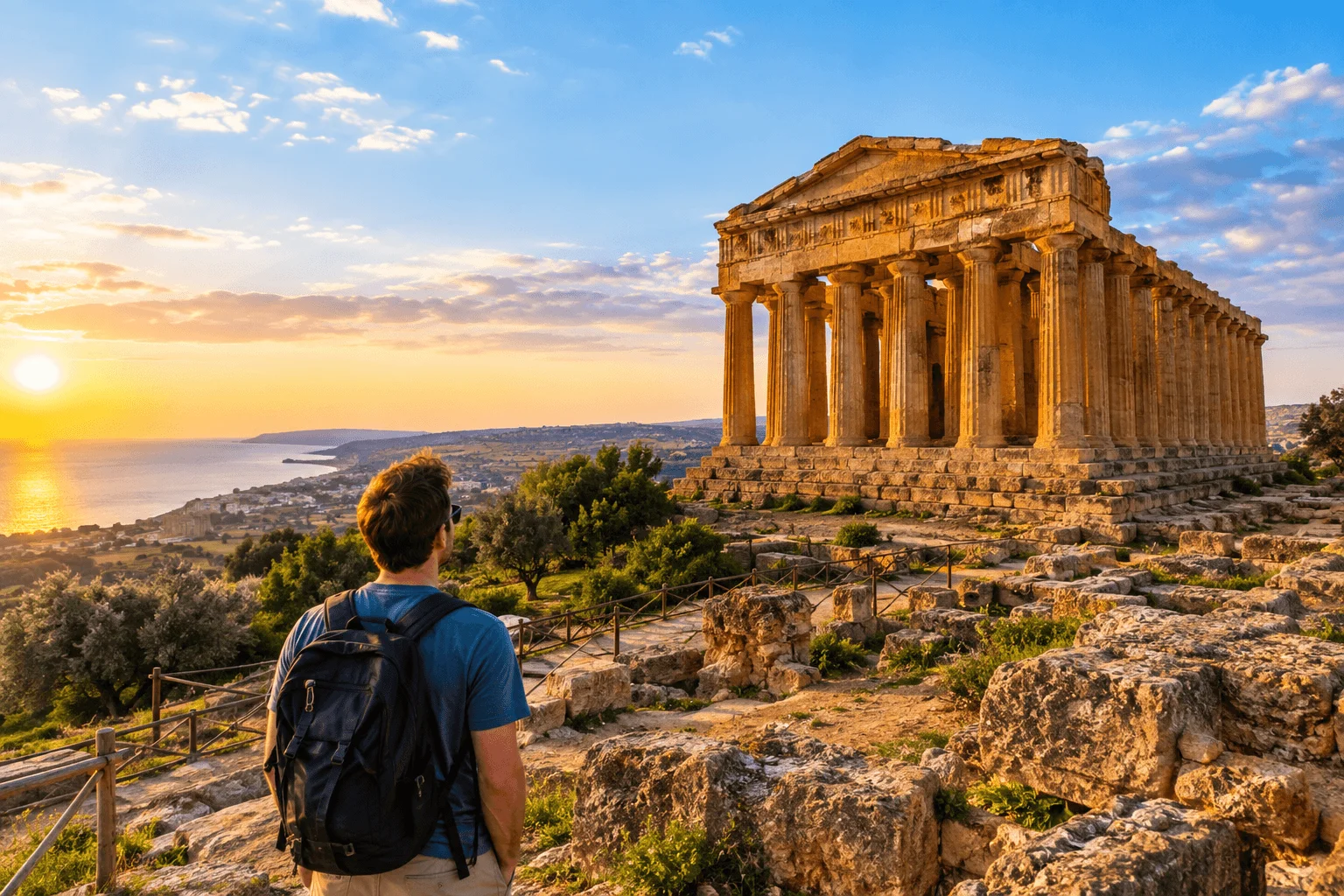
I felt like a real treasure seeker the moment I landed in Sicily. This island sits in the heart of the Mediterranean, and its history reaches back thousands of years. People have lived here since around 12,000 BC, although the story most travelers follow begins around 750 BC, when the Phoenicians and Greeks established colonies along its shores.
Over the centuries, Sicily attracted one conqueror after another. Arabs, Normans, and Spanish rulers all left their mark on the island. My tour leader, Tiziano Tomasella, joked that the Arabs stayed for nearly 200 years. I had booked the Treasures of Sicily tour through Exodus Travels, hoping to experience this incredible history firsthand.
Few places in Europe have such a fascinating mixture of civilizations. Everywhere I went, I found another layer of the past. That combination is what makes Sicily such a memorable destination for history lovers.
Quick Answer
Sicily is home to some of the most impressive ancient Greek ruins in the Mediterranean. The best places to explore include the Valley of the Temples in Agrigento, Syracuse, Neapolis Archaeological Park, Selinunte, and Taormina. These sites showcase ancient Greek temples, theatres, amphitheatres, and archaeological remains dating back thousands of years. Exploring them also reveals how Greek, Roman, Arab, Norman, and other civilizations shaped Sicily’s history. For the best experience, plan extra time for Agrigento and Selinunte, where the archaeological areas are especially large.
Exploring Sicily’s Ancient Greek Ruins
Some of the most impressive Greek ruins in Sicily are found in the western part of the island. I set aside a full day for Agrigento, where the remarkably preserved ancient structures rival many sites in Greece.
Public transportation becomes more limited around some of the archaeological sites, so I rented a car and drove to Selinunte and Segesta. Both sites impressed me with their enormous scale and remarkable preservation.
On Sicily’s eastern coast, I visited Taormina, famous for its ancient Greek theatre, and Siracusa, home to an impressive Greek amphitheatre. Along the way, I passed villages, Baroque cathedrals, Roman ruins, and an active volcano.
Whether you travel to Sicily specifically for its ancient Greek ruins or simply enjoy destinations with layers of history, this island offers something fascinating around almost every corner.
A Sicilian Odyssey: Following Odysseus to Sicily
People often ask what inspired me most about Sicily. My answer is always the same: its ancient Greek ruins.
When I was in high school, my AP English class required me to read Homer’s epic poem, The Odyssey. At the time, I never imagined that decades later I would walk through places connected to the stories of Odysseus.
Sicily still carries strong connections to Greek mythology. The island is remembered as the land of the Cyclopes, the land of the Laestrygonians, and the home of Aeolus, associated with the Aeolian Islands.
Walking through Sicily felt like stepping into my own personal Sicilian Odyssey. The combination of mythology, archaeology, and landscape made the experience feel much more personal than a typical sightseeing trip.
Hellenic Temples: Chasing a Past I Never Saw
I have never visited Greece, and that may explain some of the wonder I felt while exploring Sicily’s well-preserved archaeological sites.
Still, simply seeing ancient structures is only part of the experience. Standing among the ruins made me imagine the Greek explorers who arrived on the island centuries ago and established settlements here.
These ancient communities built temples, theatres, cities, and other structures that continue to shape Sicily’s identity today. Walking through their remains gave me a stronger connection to a past I had previously known mostly through books and photographs.
Agrigento: Standing Before the Valley of the Temples
Agrigento quickly became my favorite place to explore Greek ruins in Sicily. Located along the southern coast, the city is home to the famous Valley of the Temples, a UNESCO World Heritage Site.
I first spotted the temples in the distance as our van approached. A striking white Doric temple stood on the hill, and I immediately understood why this site is considered one of the great monuments of Greek culture.
The ancient Greek colony was founded in the 6th century BC and eventually became one of the leading cities of the Mediterranean world. The remains of its Doric temples still dominate the landscape.
Much of the ancient city remains beneath today’s fields and orchards. Excavated areas also reveal evidence from the later Hellenistic and Roman periods, as well as burial practices connected with early Christian communities.
As I climbed the sacred hill, I felt incredibly small compared with the enormous temples around me. The weather added to the atmosphere. Dark clouds gathered overhead, making the ancient structures look almost otherworldly.
Valley of the Temples: Experiencing History Among the Crowds
The Valley of the Temples was busy when I visited. Crowds moved along the pathways, stopping frequently for photographs and selfies.
Even with the crowds, I found moments when I could slow down and appreciate the ruins. I remember reaching out and touching a column while imagining the people who had stood in the same place thousands of years earlier.
We passed several important structures, including the Temple of Juno, the Temple of Concordia, the Temple of Hercules, and the Temple of Castor and Pollux.
The Temple of Concordia particularly stood out because it remains one of the best-preserved Doric temples from the ancient Greek world.
The archaeological area covers much of the ancient city, extending from Rupe Atenea to the acropolis and the sacred hill where the major Doric temples still stand.
Syracuse: Where Legend and History Meet
Syracuse is another essential stop for anyone exploring Sicily’s ancient Greek history.
The city appears throughout literature and mythology, but it was far more than an imaginary setting. Ancient Syracuse became one of the most powerful city-states in the Greek world. It also briefly served as the capital of the Byzantine Empire.
Today, walking through Syracuse can feel like exploring an open-air museum. Greek and Roman ruins appear throughout the city, while Neapolis Archaeological Park remains one of its major attractions.
UNESCO traces the city’s Greek origins to Ortygia, which was founded by Greeks from Corinth in the 8th century BC. The city later became incredibly important in the ancient Mediterranean world.
Among its surviving landmarks are the Temple of Athena, a Greek theatre, a Roman amphitheatre, and an ancient fort. The Temple of Athena was built in the 5th century BC and was later incorporated into a cathedral.
Neapolis Archaeological Park: Echoes in the Stone Quarries
Our group spent time exploring Neapolis Archaeological Park, where our local guide, Vanessa, helped bring the ruins to life.
The park contains several fascinating landmarks, including the Greek theatre, Roman amphitheatre, ancient stone quarries, the Ear of Dionysius, and the Altar of Hieron.
One of my favorite moments came inside the Grotta dei Cordari. We heard people singing an Italian song, and the cave’s acoustics carried their voices beautifully through the space.
Everyone stopped to listen. When the performance ended, our group applauded and cheered.
It was a simple moment, but experiences like that made the ancient sites feel alive rather than simply historical.
Teatro Greco: Where Ancient Tragedy Still Echoes
Choosing a favorite structure at Neapolis Archaeological Park is difficult, but Teatro Greco captured my imagination the most.
As I looked down toward the ancient stage, I could almost imagine an actor performing a tragedy by Euripides. I thought about Medea, the famous Greek tragedy in which Medea confronts the betrayal of her husband, Jason.
Our guide explained how Greek theatre worked and encouraged us to imagine watching a performance beneath the stars.
Women were not permitted to perform as actresses in ancient Greek theatre, so male actors played female characters while wearing masks.
The thought of sitting in the same theatre thousands of years later was incredible. Even today, performances are held at Teatro Greco during the summer, allowing visitors to experience this ancient setting in a completely different way.
Selinunte: One of Europe’s Largest Archaeological Parks
Selinunte was another major highlight of my journey through Sicily’s ancient Greek ruins.
The archaeological area contains seven temples, many of them built according to the Doric order, one of the oldest styles of Greek architecture.
The archaeological park also includes sanctuaries, a necropolis, the Caves of Cusa, and the remains of the ancient city.
Because the site covers such a large area, some visitors choose to explore it by golf cart. The ancient settlement stretches across roughly 670 acres, so walking between the ruins can be tiring.
We chose to walk.
The hills made the journey challenging at times, but the views toward the sea made the effort worthwhile. Standing among the ancient temples with the Sicilian coastline in the distance was one of the most memorable experiences of the trip.
The Greek Temples of Agrigento: Standing Among Akragas’s Ruins
Few archaeological landscapes show the wealth and influence of Greek Sicily as dramatically as the Valley of the Temples in Agrigento.
Ancient Akragas was founded in the 6th century BCE and quickly became one of the leading cities of the western Greek world.
Walking along the rocky ridge, I could still sense the prosperity that once existed here. The temples overlook the surrounding countryside and Mediterranean coast, creating a setting that is just as impressive as the ruins themselves.
The Temple of Concordia is one of the site’s greatest highlights. It remains an exceptionally complete example of Greek temple architecture, with even parts of its internal staircases surviving.
Traces of colored stucco also provide a reminder that these temples were not always the weathered stone structures we see today. They were once much more colorful and visually striking.
The Temple of Olympian Zeus demonstrates the enormous ambitions of the ancient city. Construction began after a victory over Carthage in the early 5th century BCE. The temple was planned on a colossal scale and included massive telamones, or human figures used as architectural supports.
Only fragments remain today, but they still give visitors a sense of how enormous the original structure must have been.
The surrounding landscape makes the ruins even more impressive. Fallen columns stretch across the ridge among almond and olive trees, while the land slopes toward the sea.
That combination of monumental architecture and open Sicilian scenery makes Agrigento one of the most memorable archaeological destinations in the Mediterranean.
Exploring the Archaeological Museum in Agrigento
After exploring the temples, I also visited the Museo Archeologico Regionale Pietro Griffo.
The museum added another dimension to the archaeological experience. Instead of seeing only enormous temples and ruined columns, I could see objects recovered from the surrounding region.
The collection includes votive statuettes, ceramics, architectural fragments, sculptures, a reconstructed telamon, and the famous 5th-century BCE Ephebe.
Seeing these smaller objects helped me imagine the people who lived in and around ancient Akragas. The temples may dominate the landscape, but artifacts like these reveal more about everyday religious and cultural life.
More Ancient Ruins Beneath the Sicilian Landscape
Much of the ancient city remains buried beneath the fields and orchards surrounding Agrigento’s temples.
According to UNESCO, the monuments remain among the finest surviving examples from the Greek world. The Valley of the Temples, known locally as Valle dei Templi, is also one of Sicily’s most important archaeological areas.
The seven temples left me speechless when I first saw them.
The Temple of Concordia is especially impressive because of its remarkable preservation. It stands as one of the most recognizable examples of ancient Greek architecture on the island.
Rather than follow a guide for every part of the site, we explored at our own pace. That gave me time to stop whenever something caught my attention.
I spent the most time at Temple C, one of the oldest structures on the Acropolis. I could see fourteen surviving columns associated with the god Apollo.
I also climbed toward Temples A and O, located on the Acropolis hill. The remains provide another glimpse into the religious life of ancient Greek Sicily.
The site’s museum contains artifacts from the ancient Greek colony, while the history of Selinunte offers another fascinating chapter in Sicily’s Greek past.
Selinunte’s Rise and Fall
Selinunte was founded as a Greek colony and enjoyed centuries of prosperity. Its name is connected with Selinon, referring to wild parsley that grew along the banks of the Modione River.
The settlement eventually became one of the largest Greek colonies in the western Mediterranean.
Its history, however, was not peaceful forever.
In 409 BC, Selinunte was attacked by Hannibal’s forces and suffered extensive destruction and plunder. The event marked a dramatic turning point in the history of the ancient city.
Today, its enormous ruins allow visitors to walk through the remains of a civilization that once flourished along Sicily’s southern coast.
For me, that is what makes exploring Sicily’s ancient Greek ruins so rewarding. You are not simply looking at old stones. You are following the rise, success, conflict, and eventual decline of ancient communities that shaped the island for centuries.
Frequently Asked Questions About Sicily’s Ancient Greek Ruins
What are the best ancient Greek ruins to visit in Sicily?
The Valley of the Temples in Agrigento, Syracuse, Neapolis Archaeological Park, and Selinunte are among the major ancient Greek sites highlighted in this guide. Taormina is also worth visiting for its famous ancient Greek theatre.
Where can I see Greek temples in Sicily?
The Valley of the Temples in Agrigento is one of the best places to see ancient Greek temples in Sicily. The archaeological area includes several important Doric temples, including the Temple of Concordia, Temple of Juno, and Temple of Hercules.
Is Agrigento worth visiting for Greek ruins?
Yes. Agrigento’s Valley of the Temples is one of the highlights of Sicily’s ancient Greek heritage. The site combines remarkably preserved Doric temples with views across the surrounding Sicilian landscape.
What is the Valley of the Temples?
The Valley of the Temples, or Valle dei Templi, is a major archaeological area in Agrigento. It contains the remains of the ancient Greek city of Akragas, including several monumental temples built in the Doric style.
What can you see at Neapolis Archaeological Park?
Neapolis Archaeological Park contains several important ancient sites, including a Greek theatre, Roman amphitheatre, ancient stone quarries, the Ear of Dionysius, and the Altar of Hieron.
Is Syracuse important for ancient Greek history?
Yes. Ancient Syracuse became one of the most powerful city-states in the ancient Greek world. Today, visitors can explore Greek and Roman ruins throughout the city, including the Greek theatre and Temple of Athena.
What makes Selinunte special?
Selinunte is known for its enormous archaeological area and collection of ancient Greek temples. The site includes seven temples, sanctuaries, a necropolis, the Caves of Cusa, and remains of the ancient city.
Can you visit Sicily’s Greek ruins without a guide?
Yes. During the trip described in this guide, some sites were explored independently. At Agrigento, for example, there was time to explore the archaeological area without following a guide at every stop. A local guide can still add useful historical context.
How much time should you spend exploring the Greek ruins in Sicily?
The amount of time depends on the sites you want to visit. Agrigento deserves at least a full day, especially if you want to explore the Valley of the Temples and nearby attractions. Larger sites such as Selinunte can also take several hours because of their size.
Are Sicily’s ancient Greek ruins worth visiting?
Absolutely. Sicily’s archaeological sites combine ancient temples, theatres, mythology, history, and beautiful Mediterranean landscapes. For travelers interested in ancient civilizations, they offer an opportunity to experience Greek history without leaving Sicily.