
Quick Answer
Claude Monet’s House and Gardens in Giverny offer visitors a chance to explore the home, gardens, and artistic world of the famous Impressionist painter. You can admire the colorful flower gardens, Japanese-inspired water garden, beautifully decorated rooms, and Monet’s collection of Japanese woodblock prints. A typical tour costs $75 per person, including round-trip transportation from Paris and the entrance fee, with about two hours to explore the house and gardens.
A Colorful Escape into Monet’s World
A 45 minute train ride from Paris brings you to Giverny, a charming village in France where Claude Monet, the celebrated artist and Impressionist painter, made his home from 1883 to 1926 with his family. I found that a visit to Monet’s House feels less like entering a museum and more like stepping inside one of his painted canvases, where every room and corner tells a story. The colorful and whimsical setting, with its pink house, green shutters, colorful house, and beautiful pictures, creates a true colorful masterpiece and a lasting source of inspiration. From the station, shuttle buses provide easy transport for tourists, making the house and Remarkable Gardens a convenient must-stop during any trip or visit to France. Like the elegant scenes associated with Jane Austen, the setting combines Romantic charm, exotic setting, and a unique place filled with vibrant colours, paintings, flowers, and the intrinsic nature of Impressionism, making it a natural gateway to the gardens of Normandy and the wider beauty of Normandy.
From the Water Garden to a Living Impressionist Canvas
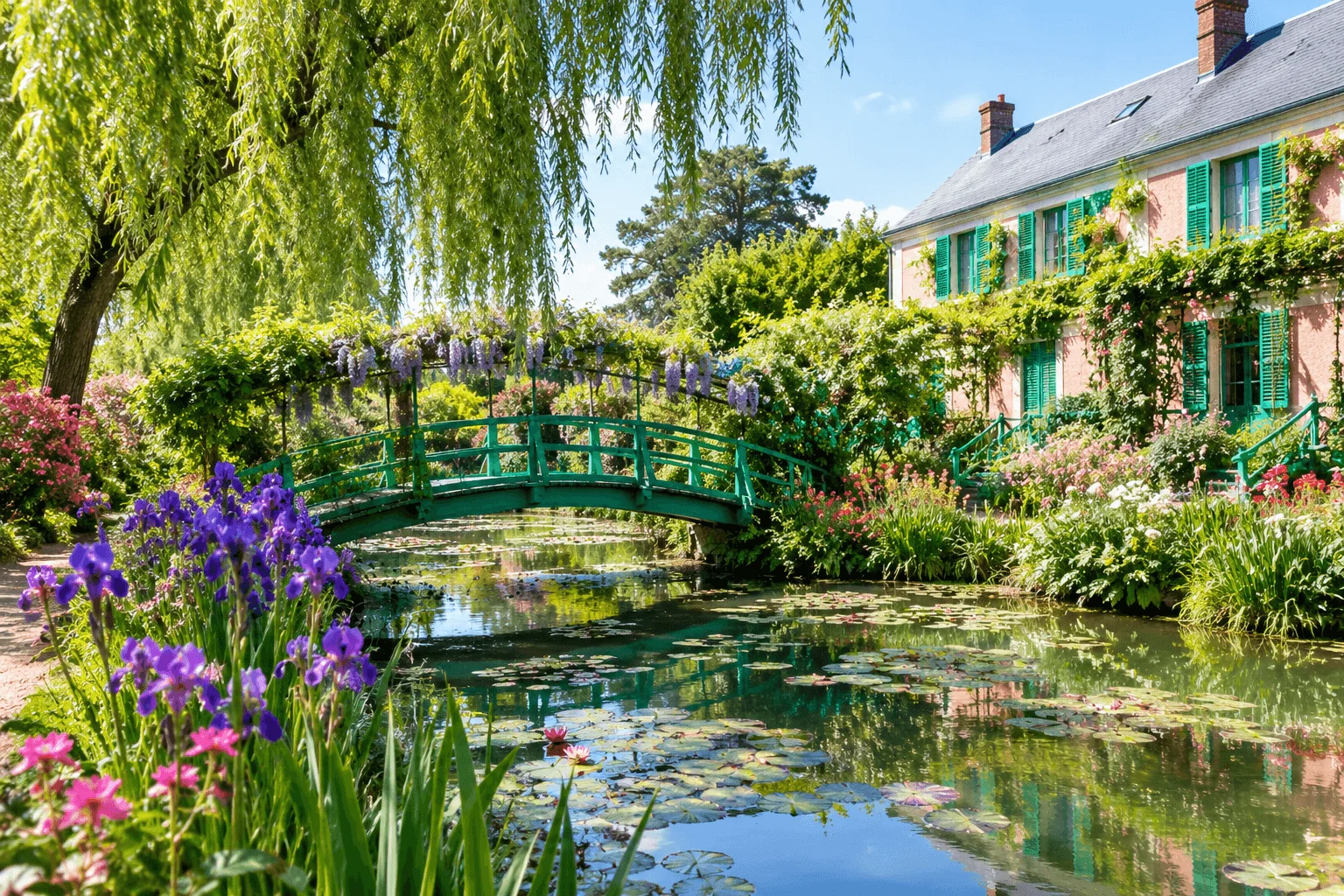
The Water Garden, which Monet created by artist himself beside the Epte, remains one of his greatest works and a place that inspired the famous Water Lilies, now exhibited at the Orangerie museum. A small arm of the river surrounds a pond filled with countless water lilies, while banks feature weeping willows, bamboo trees, poppies, and lilies. The magnificent Japanese-inspired group includes the famous little green bridge, Japanese footbridge, and hanging wisteria, revealing many of Monet’s secrets through a splendid palette of colour. Across the grounds, the Norman Enclosure and floral garden display countless climbing roses, abundant flower beds, tulips in Spring and spring, irises, roses in June, and a permanent outburst of colours that continues from Autumn through the seasons. The sumptuous gardens, identically recreated in many of their historic details, attract over half a million visitors—or half a million visitors—from around the world and can be visited all year round. For flower-lovers, Claude Monet’s gardens, Claude Monet’s garden, and the surrounding gardens feel like paradise, while the nearby graveyard and church connect visitors with the founder of Impressionism. Whether you come for French impressionists, an Impressionist, or the legacy of the French Impressionists, this famous destination offers a memorable experience shaped by Monet’s Water Garden, water garden, and enduring vision.
Artist’s Portal
Entering Monet’s Estate
You enter the estate through a trellised gate, where Musee Monet appears in script letters. Ahead, a long-walled passageway creates a strong sense of mystery and makes the entrance feel like the beginning of something special. As you move through this portal, the setting feels otherworldly and mysterious, almost as though you are stepping directly into Monet’s mind. I find this entrance especially effective because it encourages you to put aside your worries and focus on the artistic atmosphere before exploring the rest of the estate.
Seeing the World Through an Artist’s Eyes
Monet’s approach to painting becomes clear through his advice to forget what objects appear before you and instead notice their colours and shapes. He encourages painters to observe a tree, a house, a field, or whatever stands before them as simple areas of colour: a little square of blue, an oblong of pink, and a streak of yellow. This way of seeing helps explain why the estate feels so connected to his paintings and why visitors can experience the surroundings as an extension of his artistic vision.
A Passage into Monet’s Mind
The combination of the trellised gate, script letters, and long-walled passageway gives the entrance a distinctive character. Rather than simply walking into a historic estate, you feel as if you are entering an artist’s creative space. The portal becomes a transition from everyday life into a place where blue, pink, and yellow become important visual impressions, reflecting the way Claude Monet viewed the world around him.
Two Gardens
Two Distinct Gardens
Claude Monet’s House & Gardens offers visitors two different gardens, each with its own character. Monet planted the original garden, known as Clos Normand, directly in front of his house. Later, he created a second garden, a Japanese water garden, on the other side of the road. The two gardens contrast with and complement each other, giving the estate two very different views of nature and design.
A View of the Japanese Garden
I skirted the perimeter of the fenced grounds to see the Japanese-inspired water garden from a distance, almost like a peephole. This distant view offers a different perspective of the garden and lets you notice its overall arrangement without immediately walking through it. The green, blue oasis creates a peaceful scene and shows how carefully Monet shaped the landscape around his artistic vision.
Seeing the Gardens Through Monet’s Eyes
If you squeeze your eyes tight and then reopen them while looking at the green, blue oasis, you might imagine how Monet viewed his flowers through cataract eyes. Monet did not begin losing his vision until his 60s, but this change affected how he saw colors and objects in his gardens. That perspective adds another layer to a visit because the gardens were not only places he designed but also places through which he experienced changing colors and objects.
Claude Monet’s Gardens in Giverny
A must-see in Normandy, Claude Monet’s gardens in Giverny beautifully show the intrinsic nature of Impressionism through vibrant colours, paintings, and flowers. This unique place acts as a gateway to the gardens of Normandy, with a famous water garden, pond, water lilies, and Japanese footbridge that allow visitors to discover the garden’s secrets. You can visit the gardens all year round, while each season brings something different: in spring, tulips appear first, followed by irises, and then roses in June, creating a permanent outburst of colours. The visit can then continue into the colourful house, adding another memorable part of the experience. Nearby, the founder of Impressionism rests in the graveyard by the church. The destination also offers useful visitor information covering About, Opening / reception hours, Rates, and Services and equipment, while photographs by Aurelien Papa provide additional views of Claude Monet’s House and Gardens.
Monet’s Water Lilies
The water lily, also known as nymphaeaceae, is a flowering plant that grows on water in temperate and tropical climates, and Monet grew these plants in his Japanese gardens. Although he did not originally plan to become known as the painter of water lilies, he grew them naturally and eventually allowed them to become deeply connected with his senses and artistic vision. His pond became a source of inspiration, leading him to take up his palette and paintbrush and focus on the wonders before him. This connection between the water lilies, Japanese gardens, and his creative process helps explain why these flowers became such an important part of Monet’s artistic legacy and the wider story of Impressionism
Forest Bathing
Japanese-Inspired Forest Bathing
Although the concept of Japanese-inspired forest bathing did not exist in the 19th century, Claude Monet would likely have appreciated this calming habit because his artistic vision closely connected nature with inspiration. Spending time among trees, plants, and peaceful surroundings can encourage visitors to slow down and notice the natural details around them. Monet’s words, “The richness I achieve comes from nature, the source of my inspiration,” capture this connection well. His appreciation for natural beauty also makes forest bathing a fitting way to experience the peaceful atmosphere associated with his gardens, much like the Enid Haupt Sculpture Garden, where this practice can offer a quiet break from everyday life.
A Bucolic Garden Leads to the House
The bucolic garden creates a beautiful approach to the house, and its appearance changes with the seasons, giving the estate a different character throughout the year. I had already shared my impressions of this garden, but the next part of the visit focuses on an important aspect of the estate: the home, refuge, and studio of one of the greatest painters who ever lived. Moving from the garden toward the house makes the experience feel more personal, as the peaceful surroundings lead naturally into the space where an important artist lived and worked.
Inside the Home of a Great Artist
I always find visiting the homes of great individuals fascinating, especially when those people were creative people such as artists or writers. Stepping into their intimate spaces allows me to observe details that may have influenced and inspired their work. I enjoy taking plenty of photos and notes during these visits because an artist’s vision can often prompt new ideas and reflections. Rather than simply seeing a historic building, I can connect the surroundings with the person who once lived there and better understand the environment that shaped their creative work.
A Visit That Exceeded Expectations
My visit to Giverny certainly exceeded my expectations. The combination of the garden, the home, and the personal atmosphere of the estate creates a memorable experience for anyone interested in creative lives. After spending time among the seasonal plants and exploring the spaces connected with the artist, I felt that the visit offered more than I had expected. It gave me an opportunity to reflect on how vision, inspiration, and everyday surroundings can influence the work of great individuals.
The Dining Room and Kitchen, Central Rooms in Claude Monet’s Home
The yellow of the dining room and reception room immediately stands out as the place where the Monet family gathered daily. This bright, cheerful chrome yellow stimulates the senses and gives the vast room a warm country charm. The bold color clearly shows the influence of a man who worked with color. A large table sits at the center, ready to welcome friends, while two imposing china cabinets add grandeur. Numerous Japanese prints create an exotic flair, and the blue and white checkered cushions on the chairs add another pleasing detail.
The tour continues to the kitchen, which may seem less important because it held little significance for the painter, yet it remains a favorite place for many visitors. The space perfectly represents a true French country kitchen and becomes a real source of inspiration. As an extension of the dining room, it combines practicality and common sense without losing its charm. The thoughtful design makes the kitchen feel both useful and inviting.
The kitchen also features copper pans, a stone sink, and a superb kitchen range highlighted by earthenware tiles. Large, beautiful doors likely concealed shelves filled with provisions, adding to the practical character of the room. Together, these details create an authentic country atmosphere and show how carefully Claude Monet’s home balanced function, comfort, and visual appeal.
Autumn Splendor
When visiting Giverny in October, the garden takes on a completely different character. The flower palette shifts to rich autumn shades, with burgundy leaves, orange and red mums, and yellowing strands of grass creating a warm seasonal display. Instead of the bright colors of summer, the garden reflects the quieter beauty of autumn.
The water lilies also change with the season. They had lost their flower “bonnets,” leaving only their flat cup-shaded leaves floating lazily across the water. This peaceful scene reflects Claude Monet’s belief that a landscape constantly changes. As he observed, “For me, a landscape does not exist in its own right, since its appearance changes at every moment.” This idea helps explain why the changing garden remained so important to his artistic vision.
Pretend World
If you can steer of the crowds and find a quiet nook in the garden to hide, you can more easily enter Monet’s world. This peaceful approach lets you slow down and experience the garden without distractions. Instead of simply walking through, take time to notice the details around you and imagine the garden as Monet might have experienced it.
Woodblock Prints
Claude Monet became an ardent collector of Japanese woodblock prints, also known as ukiyo-e, after discovering this artwork in Amsterdam in 1871. Interestingly, people used some of these prints as wrapping paper in an Amsterdam food shop. Monet developed a strong interest in Japanese art, and his collection eventually grew to more than 200 prints.
His collection included works by important artists such as Kitagawa Utamaro, Katsushika Hokusai, and Utagawa Hiroshige. Monet was not alone in admiring Japanese art, which became known as “japonism” during the second half of the 19th century. Other famous painters and artists, including Vincent van Gogh, Auguste Rodin, and James Mac Neil Whistler, also collected ukiyo-e engravings.
Monet carried this Japanese influence into his own gardens. He laid out his Japanese gardens like a woodblock print, using strong geometric lines created through the installation of fences and his bridge. This thoughtful arrangement helped connect his passion for Japanese prints with the design of his garden, turning the landscape into a carefully composed artistic scene.
Monet’s House
Monet’s house is quite wide and resembles an inn. The rectangular brick building stands covered in ivy, with a main entrance and a side entrance. Visitors can also look through the second-story windows and see down onto the gardens. Its simple but distinctive structure fits naturally into the surrounding landscape.
From the moment Monet glimpsed this house in rural France, he knew he wanted to own it. He developed an immediate connection with the charming home, which became an important part of his life. According to Giverny.org, “It was in 1883 that Monet fell in love at first sight for this charming house that he discovered during a walk. He lived in it until his death, in 1926.”
Although 98 years had passed since Monet lived in his Giverny house, his spirit could still be felt there. The artist did more than paint canvases; he filled his world with bold colors and artistic expression. His home and gardens continue to show how closely he connected everyday surroundings with his creative vision.
Interior Decoration
Plan for at least 30 minutes to tour Monet’s house and explore its interior spaces. On the ground floor, visitors can enter the reading room, still known as the little blue lounge. This room connects to the pantry, where the household stored tea, olive oil, spices, and eggs in cupboards. A virtual tour can also give visitors a closer look at these rooms.
Next, enter the artist’s first studio, where Monet worked until 1899. The team restored the studio in 2011, while keeping its layout similar to the way it looked during Monet’s time. The studio/lounge therefore gives visitors a sense of how the artist used the space as part of his creative life. A second virtual tour can provide another way to explore this area.
The beige floral upholstery gives the room the appearance of a conservatory, while cozy sofas and recliners create an inviting atmosphere. Framed portraits of family members add a personal touch and contrast with the wall-to-wall display of Impressionist paintings. Together, these decorative details reveal how Monet’s home combined comfort, family memories, artistic influences, and distinctive interior style.
Monet’s Cat
As anyone who reads my blog knows, I am obsessed with cats. During my week in France, I looked everywhere for felines in Paris. I saw dogs everywhere, but I couldn’t find a cat. After I returned home, I learned that the street cats sleep at Montmartre Cemetery.
Naturally, I thought I might find a resident cat at Monet’s house, especially with its many soft chairs and sofas that seemed perfect for a puss. However, I didn’t spot one during my tour.
Instead, I discovered a ceramic sleeping cat in the dining room. Although it wasn’t a real feline, the charming ceramic cat still felt like a fitting little detail inside Monet’s home.
Honoring Monet
I made a pilgrimage to Giverny to see his gardens and walk in his footsteps. As art lovers, we have the privilege of visiting the place where the artist lived and worked. Standing there made the experience feel deeply personal, and I imagined that the clock in the kitchen stopped ticking after Monet died.
His friend Gustave Geffroy captured Monet’s connection to Giverny beautifully. He believed that visitors had to see Monet in Giverny to understand his character, thirst for life, and private nature. He also described this house and this garden as artworks, reflecting how Monet spent his life creating and perfecting them.
Tour Cost
A typical tour cost is $75 per person, which covers the round-trip motor coach fare from Paris and the 12 euro entrance fee to Claude Monet’s home in Giverny. You’ll have about two hours to explore the house and gardens and enjoy the visit.
Focus Keyphrase: Claude Monet’s House and Gardens
Meta Description: Explore Claude Monet’s House and Gardens in Giverny, including the beautiful gardens, home, tour cost, and what to expect during your visit.