
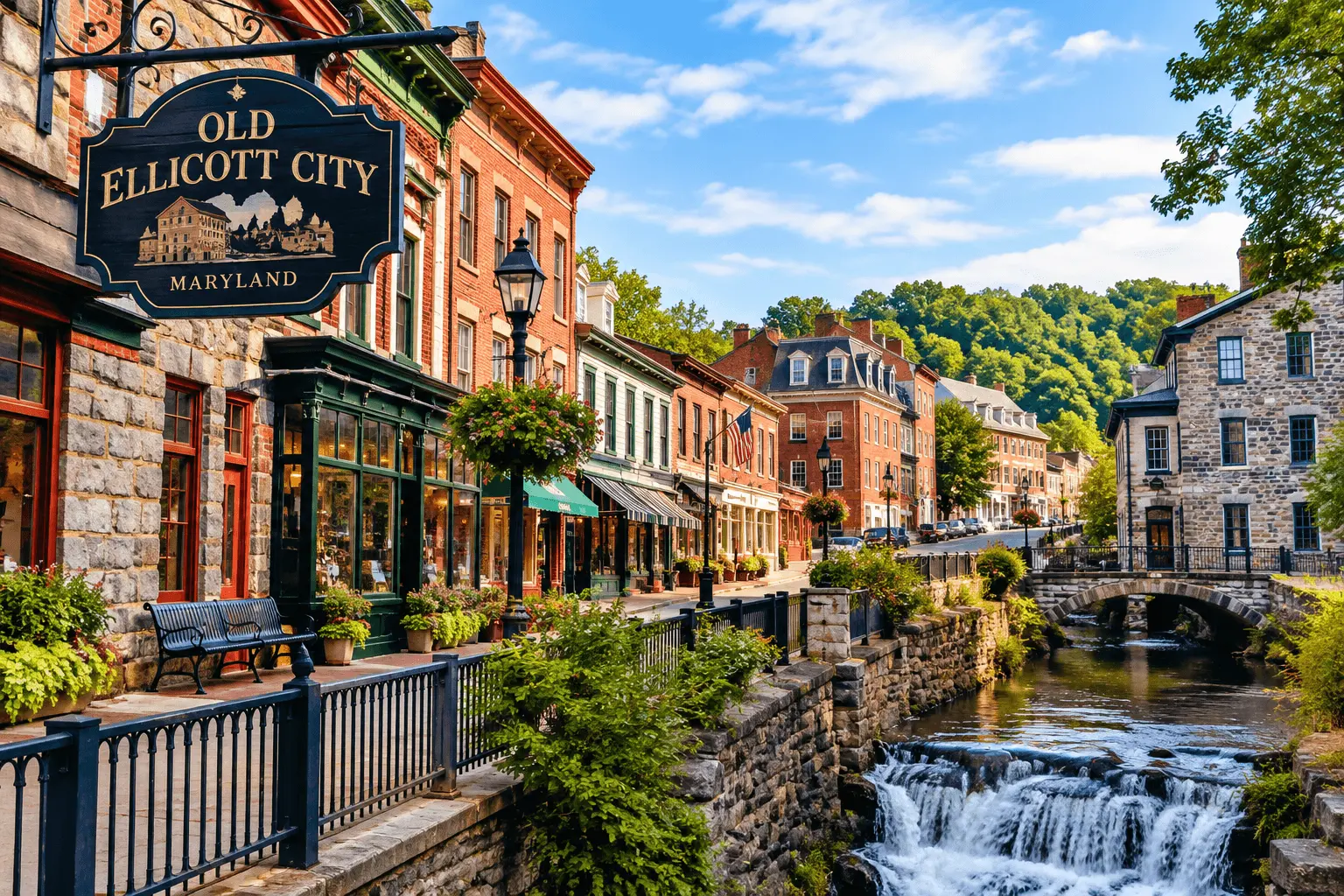
Old Ellicott City offers a relaxed way to explore Maryland’s past while enjoying its local character. I especially like starting with the B&O Ellicott City Station Museum, then walking through the picturesque streets toward Backwater Books. Families can enjoy ice cream and baked goods, while Solo travelers can find peaceful nooks to relax, spend time journaling, or simply enjoy the quiet spots around Ellicott City. The mix of history, shops, and small local places makes the town easy to explore at a comfortable pace.
For a slower afternoon, you can visit Clayground for a pottery workshop, stop at Manor Hill Tavern for a drink, or enjoy the local craft brews and craft beer scene. Reflecting on the town’s character becomes easy as you move between its historic spaces, museum, books, pottery, and tavern. You can also end the day with a reflexology session and a relaxed conversation, making Old Ellicott City feel both historic and welcoming.
Quick Answer
Old Ellicott City, Maryland, is a historic destination filled with preserved buildings, museums, churches, railroad landmarks, historic homes, and fascinating local stories. Visitors can explore Historic Main Street, the B&O Ellicott City Station Museum, George Ellicott House, Patapsco Female Institute, Historic Howard County Courthouse, and many other landmarks. The town also offers local shops, restaurants, and historic sites that make it a memorable destination for history lovers, families, and travelers exploring Maryland.
Log Cabin HO-64
Log Cabin HO-64 has a unique place in Old Ellicott City history. Originally located on Merryman Street, the cabin served as the first meeting place for the organizers of St. Luke AME Church. Experts believe it dates to the early 1800s, although the structure may be older. Fannie Stanton donated the cabin to Historic Ellicott City, Inc. in the early 1980s, preserving an important part of the community’s past.
After the donation, workers dismantled the cabin and stored it until the county found a suitable site for its reassembly. The historic structure later moved again in its entirety after the 2018 floods, showing the challenges of preserving historic buildings in the area. In 2020, the cabin returned to its current location, where visitors can appreciate its history and connection to the community.
Talbott Lumber HO341
Talbott Lumber began in 1845 in Ellicott City, founded by Edward Alexander Talbott, who operated the business through much of the 19th century. The original location stood on the Baltimore County side of the Patapsco River, where frequent flooding affected the business. In 1903, his son, also E.A. Talbott, rebuilt the company as a three-story building at 8308 Main Street. In 1908, ownership moved to brothers Richard Talbott and Thomas Talbott, continuing the family’s connection to the historic business.
After one brother died in 1945, the surviving brother sold the business to Nathan Holzweig. When Holzweig died in 1971, his sons-in-law, Benjamin Rosen and Milton Mazer, took over the operation. Rosen died in February 1991, and Milton closed the store in July 1991, ending a long chapter in the history of Talbott Lumber. This information comes from The Howard County Times, dated July 11, 1991
Disney’s Tavern (CA 1790) HO 82
Disney’s Tavern stands among the oldest and most historic landmarks in Old Ellicott City. Deborah Disney ran the tavern from 1840–1862, making it a popular gathering place for men. The building continued operating as a tavern through the late 19th century, reflecting the changing social life of the historic town. Its long history makes it an interesting stop for visitors exploring Ellicott City and its preserved historic buildings.
Over the years, the property changed uses and later became a fabric store, women’s boutique, and antique bookstore. These different businesses add to the building’s story and show how one historic site adapted over time. When exploring Old Ellicott City, I find places like Disney’s Tavern especially interesting because they connect everyday businesses with the town’s broader history.
Starr Funeral Home (CA 1887)
Starr Funeral Home has an interesting history in Old Ellicott City, beginning with a two-story frame print shop on the site in 1887. In 1919, Scott Starr purchased the building and converted it into a funeral home. He also offered autos “for hire”, adding another service to the property. The building later received a new brick addition, while workers renovated the original frame structure.
Over time, the property changed again and became known as Starr Apartments. It eventually housed many different businesses, showing how the building adapted as Old Ellicott City developed. When exploring the historic district, I find buildings like this especially interesting because their changing uses reveal different chapters of the town’s commercial history.
Howard House Hotel HO-68
The Howard House Hotel HO-68 has a memorable story tied to the history of Old Ellicott City. J. Shipley built the hotel, which was later twice auctioned. In 1879, the Eckert’s purchased the property and became known for serving such popular food that the hotel eventually grew larger. The public could also use a shortcut through the hotel, which connected the building to the upper street and court house.
This shortcut offered more than convenience. Eckert understood that people would notice the delicious aromas coming from the hotel and feel enticed to dine there. This clever connection between the public walkway and dining room added character to the property. The building was later converted to apartments, giving the historic site another chapter in its long history.
Walker Chandler House HO-69
The Walker Chandler House HO-69 began as a private residence and features a distinctive 3-1/2 story granite block structure. Builders constructed it into solid rock on a slope, allowing the entire first floor to serve as the foundation. Over the years, the building housed several businesses and organizations, including Kinsey’s bookmaking shop, a tavern, the American Red Cross, C&P Telephone Offices, and Yate’s Record Store.
In 1962, Ellicott’s Country Store opened in the building and became an important part of the area’s revival. The store is credited as the catalyst for the revitalization of the Ellicott City Historic District, helping bring renewed attention and activity to the historic community. When exploring Old Ellicott City, this building stands out because its architecture and changing uses reflect the district’s long commercial and social history.
ODD FELLOWS LODGE HO-79
The Odd Fellows Lodge HO-79 has an important place in the history of Old Ellicott City. The building originally served as a harness shop before the Independent Order of Odd Fellows purchased it in 1863 for approximately $2,000. The Order has kept the building in continuous use ever since, making it a lasting part of the community’s history.
Architecturally and historically significant, the building features a 3-1/2 story design with a gabled-roof and stone granite construction. It also stands out as one of the few detached structures on Main Street, giving visitors another distinctive example of the historic architecture that defines Old Ellicott City.
Patapsco National Bank HO-52
The Patapsco National Bank HO-52 reflects the historic character of Old Ellicott City through its Neo-Colonial Style design. Builders used Doric columns and large squared corner stones to create a strong appearance that gave visitors a sense of banking stability. Inside, the elegant interior added a more welcoming touch to the historic bank.
The building became especially known for its attractive room for ladies, which included a fireplace, desks, and an adjoining toilet room. The bank later became the First National Bank before it finally closed in the 1980s. Today, its architecture and history add another interesting chapter to the story of Old Ellicott City.
Hunt’s General Store (CA 1840) HO-88
Hunt’s General Store (CA 1840) HO-88 includes three homes built in a simple cut stone and frame style on lots purchased in the 1834 lottery. During the 1840s, the Hunt siblings used the lower sections as a millinery shop and dry goods/grocery store, making use of the large display window to showcase their merchandise. These early businesses helped the property become part of the commercial story of Old Ellicott City.
Over time, the buildings served several other purposes, including a bar, pool hall, and taxi stand. After Hurricane Agnes Flood, the Cacao Lane Restaurant opened at the property in 1974, adding another chapter to its changing history. The different uses show how this historic site adapted to the needs of the community over the years.
Lauman House (CA 1800) HO-98
The Lauman House (CA 1800) HO-98 ranks among the oldest homes in EC, reflecting the long history of Old Ellicott City. After the turn of the century, the Kraft’s, among others, owned the home. Following the 1972 flood, Alda Baptiste Castaldi restored the property and operated a specialty dress shop there for 30 years, giving the historic home a new purpose.
Later, renovations for Obladi (2010), the town’s first hotel since the 50’s, helped preserve important details of the building. During the work, crews restored the original woodwork and mantelpieces, allowing visitors to see more of the home’s historic character. The restoration helped protect this important part of Old Ellicott City’s architectural past.
Old Stone Tavern House HO-62
The Old Stone Tavern House HO-62 has served many purposes throughout the history of Old Ellicott City. Thomas McCrea originally owned the property, and by 1887, people sold sewing machines and notions here. The building later became home to Goldberg’s Store, among other businesses, showing its long role in the town’s commercial life.
During its 1925 renovations, the property also housed Caplan’s Dept. Store. The 3-story brick and stone building later received stucco after the 1972 flood, changing its exterior while preserving another chapter of its historic story.
Old Railroad Hotel HO-86
The Old Railroad Hotel HO-86 was built in 1847 by Andrew McLaughlin as a hotel for railroad men. The property originally had about eighteen rooms, and each room had a fireplace, giving the hotel a comfortable setting for travelers and railroad workers. Over the years, the building changed from its original purpose and became home to a variety of retail businesses, adding another chapter to its long history in Old Ellicott City.
The Patapsco Hotel HO-70
The Patapsco Hotel HO-70 is a distinctive stone building that stands 12 bays wide and 3 stories high. It replaced the original Patapsco Hotel, which workers dismantled stone by stone. They then used the old hotel’s rubble to create the current building, connecting the newer structure with the site’s earlier history.
The builders also retained the old hotel’s wall section, windows, doors, and name. Later, the property was converted to apartments, while 1st floor storefronts provided space for businesses, including a shoemaker shop. This changing use reflects how historic buildings in Old Ellicott City adapted over time.
George Ellicott House BA-602
The George Ellicott House BA-602 was built in 1789 by George Ellicott, a Quaker who worked as a miller, surveyor, merchant, and astronomer. He was also a friend and advisor to Benjamin Banneker, America’s first black man of science, who visited the house. George Ellicott also welcomed Chief Little Turtle and other Indian chiefs, making the home an important part of the area’s early history.
The house faced serious damage from floods in 1972 and 1975. After stabilization, workers moved the house across the road to its current site in 1987. They later restored it in 1990-91 under the auspices of Historic Ellicott City, Inc., helping preserve this historic property for future visitors.
B&O HO-71
The B&O HO-71, also known as the Baltimore and Ohio Ellicott City Station Museum, is recognized as the oldest railroad station in America. The station marks the terminus of the first 13 miles of Baltimore and Ohio Railroad, which was founded in 1827 as the first common carrier railroad in the United States. The railroad took its name from Baltimore, its point of origin, and the Ohio River, its intended destination. Passenger services to Ellicott City, then called Ellicott’s Mills, began in May 1830. At first, travelers used horse-drawn rail cars between Baltimore and Ellicott’s Mills. In August 1830, the B&O demonstrated the first American-built steam locomotive, the Tom Thumb, at Ellicott’s Mills.
The Ellicott City station was built in 1831 and originally served as a freight depot. In 1857, workers renovated the station to accommodate passengers. Passenger service ended in 1949, while freight service continued until 1972, when Hurricane Agnes caused damage that led to its closure. The station became a National Historic Landmark in 1968. After its closure, Historic Ellicott City, Inc. restored the station, which is now managed by the Historic and Cultural Resources Section of the Howard County Department of Recreation and Parks. Source: Howard County Government
The Phoenix Emporium HO-330
The Phoenix Emporium HO-330 has a long history as a place for purveyors of libations in Old Ellicott City. The lot was once owned by the family of cabinet makers Bernard Fort and formed part of the 1834 land lottery. This corner later became an important gathering place as several businesses served the local community.
O’Brien’s Saloon, Fissell’s, Valmas Brothers Inn, and the Phoenix Emporium have all occupied this corner and proudly served patrons for over a century. Their long presence reflects the building’s role in the social and commercial history of Old Ellicott City.
Collier’s Grist Mill HO-83
Collier’s Grist Mill HO-83 was a stone mill used for processing grain from the mid to late 1800’s. A wooden bridge once crossed the Tiber, giving people a way to reach Main St. The mill later became important to the town’s early power system when, in the 1890’s, Herman Shriver formed a company with local investors to use the mill’s water power and steam to provide the first electric power and lights to the town.
Around 1904, the operation became the Patapsco Light & Power Co plant, adding another important chapter to the industrial history of Old Ellicott City. The mill’s changing role from grain processing to electric power shows how local industry helped the town develop and modernize.
Collier’s Grist Mill HO-83
Collier’s Grist Mill HO-83 was a stone mill used for processing grain from the mid to late 1800’s. A wooden bridge crossed the Tiber and provided access to Main St. In the 1890’s, Herman Shriver formed a company with local investors and began using the mill’s water power and steam to provide the town’s first electric power and lights.
The mill later became the Patapsco Light & Power Co plant around 1904, giving the historic site an important role in the development of Old Ellicott City. Its transition from grain processing to electric power shows how the town’s industries changed over time.
TAYLOR’s (circa 1924)
TAYLOR’s (circa 1924) began a new chapter after the 1915 fire, when Irving Taylor built this new building as the fourth location for the business. The business changed over time, growing from jewelry and optometry to music boxes and later home appliances. At that time, these appliances used motors powered by generators, reflecting the changing technology of the period.
In 1970, Marvin L. Sachs purchased the building from his uncle and operated Taylor’s Antique Mall there for over 40 Years. This long period of operation adds another important chapter to the commercial history of Old Ellicott City.
Day-French-Puhl House (CA 1842) HO 313
Day-French-Puhl House (CA 1842) HO 313 is one of the oldest historic homes in Old Ellicott City. Day, a master stone mason, purchased the lot from the Ellicotts and built this Federal style home, which became one of the oldest brick structures in the district. Rear and side additions were made before 1887, adding to the building’s long architectural history.
The property later became the home to the French family for many years, followed by the Puhl family beginning in 1957. The Puhl family restored the home during their tenure. In 1999, new owners carefully adapted the property as Envy Salon. It is currently a private home once again, continuing its long history of changing uses.
Tongue Row 3732 (Old Columbia Pike) HO-309,310-311
Tongue Row 3732 (Old Columbia Pike) HO-309,310-311, also known as Tonge Row or Tongue Row, was built in the 1840s, with one duplex completed each year by Ann Tonge, a widow. The three structures served as rental units for Ellicott City’s mill workers. The buildings face Old Columbia Pike and stand two stories on the road, while each has a walk-out bottom floor in the back.
Each duplex side has an upper and lower door and a central chimney, giving the historic buildings a distinctive design. The three lovely stone buildings have reportedly appeared in movies and television productions, including the TV film Les Miserables in 2000 and the Pied Piper of Hamlin. Their architecture and screen appearances add to the historic character of Old Ellicott City.
YATES MARKET
YATES MARKET HO ? has a long connection to the commercial history of Old Ellicott City. In 1905, SJ Yates opened his grocery store at 8247, a building that had formerly been a home from the mid 1800’s. He used a Model T truck to provide free home deliveries, bringing groceries directly to local customers.
In 1925, SJ Yates moved the grocery business to his newly-constructed building at 8249. In 1938, his grandson, Bladen, opened a hardware store in the original building. The Yates family continued to operate these businesses for 4 generations, making the site an important part of the town’s local business history.
Old Main Street Post Office (Howard County Welcome Center) HO 752
The Old Main Street Post Office (Howard County Welcome Center) HO 752 stands on a site with a long commercial history. During the 1800’s, the location housed Hillsinger’s Undertaking Parlor, a livery, wagon and carriage shop, and blacksmith shop. In 1940, workers tore down these buildings to make way for a brick post office, creating a new landmark on Main Street.
In 1942, 21-year-old Petro Paul D’Anna painted the murals that still remain today. After serving as the Main Post Office for Ellicott City, the building took on a new role in 2011 as the Welcome Center and Tourism office, continuing its place in the community while preserving its historic artwork.
SUNFLOWER CHURCH HO 55
The SUNFLOWER CHURCH HO 55 has a long history in Old Ellicott City. Samuel Ellicott deeded this lot in 1837, making the church the fourth oldest Methodist Church in continuous use in the county. During renovations in 1887, workers added stained glass and painted windows, giving the church much of its distinctive character. Its nickname comes from the pattern of the large round window.
The church also played an important role during the Civil War era. Union troops stationed in town, as well as soldiers on their way to battle, worshipped here. This connection to local religious and wartime history makes the church an important historic site to explore in Old Ellicott City.
Emory Street Jail HO-54
The Emory Street Jail HO-54, also known as the Emory or Howard County Jail, was built in 1878 and became known as Will Grove. From its early years, the jail had a serious role in the town’s history. Executions by hanging took place between the jail and the Courthouse, with local men as witnesses, until 1916.
In the early 1980’s, officials added a new detention center in Jessup, Maryland. Even after that change, the Sheriff’s department continued to use the Emory Street Jail building until 2022. Its long service reflects another important chapter in the history of Old Ellicott City.
Howard County Children’s Museum HO-285
The Howard County Children’s Museum HO-285 was originally known as the Ellicott’s Second School and later became known as the Weir House. It was the second school established by the Ellicott’s and may have served as a hospital during the War of 1812. After its early educational role, the building became a residence for many years, adding another chapter to its history in Old Ellicott City.
The property later became the home to the county commissioners, followed by Planning and Zoning and finally the Howard County States Attorney’s office. Today, its current use is a children’s museum operated by the Howard County Historical Society, giving the historic building a new role for families and children.
Museum of Howard County History HO 50
The Museum of Howard County History HO 50 was formerly the 1st Presbyterian Church, which was built in 1844. In 1894, workers rebuilt the building in a cruciform design, giving it a distinctive architectural form. The building later became connected to the preservation of local history when it was given to the Howard County Historical Society.
In 1958, Alda Hopkins Clark donated the building to the society in loving memory of her husband, Judge James Clark, so it could serve as their headquarters. Today, the building operates as the Museum of Howard County History, preserving and sharing the area’s past in Old Ellicott City.
Historic Howard County Courthouse HO 51
The Historic Howard County Courthouse HO 51 was Howard County’s second courthouse, designed and built with native granite between 1840 and 1843. It stands high atop Capitoline Hill above Main Street in Ellicott City, giving the historic building a prominent place in the town. The courthouse replaced the much smaller original first courthouse, which once stood near Main Street and Ellicott Mills Drive.
The courthouse underwent renovations in the 1980’s and continued serving the community for many years. It was closed permanently in 2022 when officials opened a brand-new facility on Route 108. Today, the historic courthouse remains an important part of Old Ellicott City’s architectural and civic history.
Mt. IDA HO 59
Mt. IDA HO 59 was commissioned by William Ellicott, who hired architect N. G. Starkweather and builder C. Timanus to create the home. They built it with rubble stone and finished the exterior with old Maryland Gold stucco in the 1850’s. The property later became home to Judge John Snowden Tyson, whose surviving maiden daughter Ida lived there until the 1920’s.
The home later housed the Louis T. Clark family of 13, adding another chapter to its residential history. Charles Miller purchased the property in the 1970’s and converted it to offices. The house also became an HEC, Inc. Decorator Show House in 1995 and 2013, showing how this historic property continued to serve new purposes in Old Ellicott City.
Patapsco Female Institute HO 60
The Patapsco Female Institute HO 60 is now a historic park with stabilized ruins, operated by the Howard County Department of Recreation & Parks. The site once served as a school for young ladies ages 12-18 and opened on January 1, 1837, welcoming a few students, including Maryland State scholars. Almira Hart Lincoln Phelps served as the third principal from 1841-1846. She was a distinguished author who wrote textbooks on Chemistry, Botany and Biology, as well as novels. The school’s focus on the study of sciences was groundbreaking for young women at that time.
The school closed in 1890 and later became a private home, followed by a hotel called Burg Alnwick and finally a summer theater called “Hilltop Theatre”. The last owner deeded the building to his alma mater, the University of Cincinnati. In the 1960’s, the preservation group Friends of the PFI fought to establish the site and tell the history of the school, helping preserve its important role in the history of education for young women.